Gershon Siegel


About The Enneagram
You may be drawing a blank on the term "Enneagram." Maybe you've heard of it? Maybe you haven't. Maybe your Aunt Bess told you she was a "3" and thought you might be a "6". What the...?!
Back in September of 1994, Newsweek Magazine published a piece on the Enneagram symbol called "To Find Self, Take a Number." The article explained that the Enneagram divided people into nine types and was "moving into the mainstream." This prove to be rather prophetic because in the intervening 36 years since that Newsweek feature first appeared, the Enneagram is now everywhere.
The word "Enneagram," comes from the Greek terms, "ennea," for 9, and "gram," for "sign" or "drawing." Perhaps developed several thousand years ago alongside the decimal system, the symbol first appeared as a representation of the implicate order of an evolving universe. However, in its modern incarnation, theorists of the Enneagram, as mentioned above, have projected a system of personality typing onto it which has proven to be uncannily accurate. So much so that in recent years it has been widely adopted in the human resource departments across corporate America. The Enneagram of Personality is now being used along with such tests as the Myers-Briggs Type Indicator (MBTI) and The Big Five (Five Factor Model).
Because the Enneagram addresses the why behind behavior rather than just describing behavioral styles, the business community has become particularly open to its usefulness in leadership development, coaching, and team-building contexts.
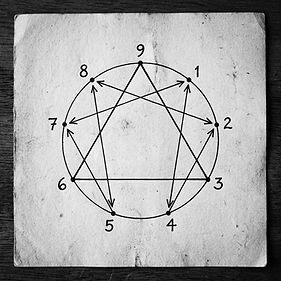
As the accompanying graphic shows, the Enneagram circle has nine points. When speaking of types, each of these nine points represents a central survival strategy that we, as little ones, developed. These strategies became our habitual, unconscious patterns and emotional motivators. Each type, so the theory goes, has strengths as well as well as challenging areas. In identifying and contemplating our "point" on the Enneagram, we begin to see our unconscious patterns and thus make them conscious.
9 Point Enneagram
For example, an Ennea-type 2, sometimes called "The Giver," habitually puts others' needs before their own. Through working with the Enneagram, a Type 2 can learn how to ask others to help meet their own needs. Or, an Ennea-type 7, sometimes called "The Enthusiast", is prone to excess and seeking excitement. Type 7s can learn satisfaction through stability and small steps. Besides unlocking our individual potential, waking up to the patterns of our type leads to a more fulfilling life as well as more balanced relationships.